

Sorting through dozens of blog posts can quickly feel overwhelming when you need results that actually drive engagement and leads. For many American startups, scattered content often hides serious value waiting to be unlocked. By focusing on credible blog content assessment and strategic segmentation, you can discover which posts hold the most promise for repurposing, helping you build a dynamic, multi-channel marketing engine that draws attention and delivers new opportunities.
Table of Contents
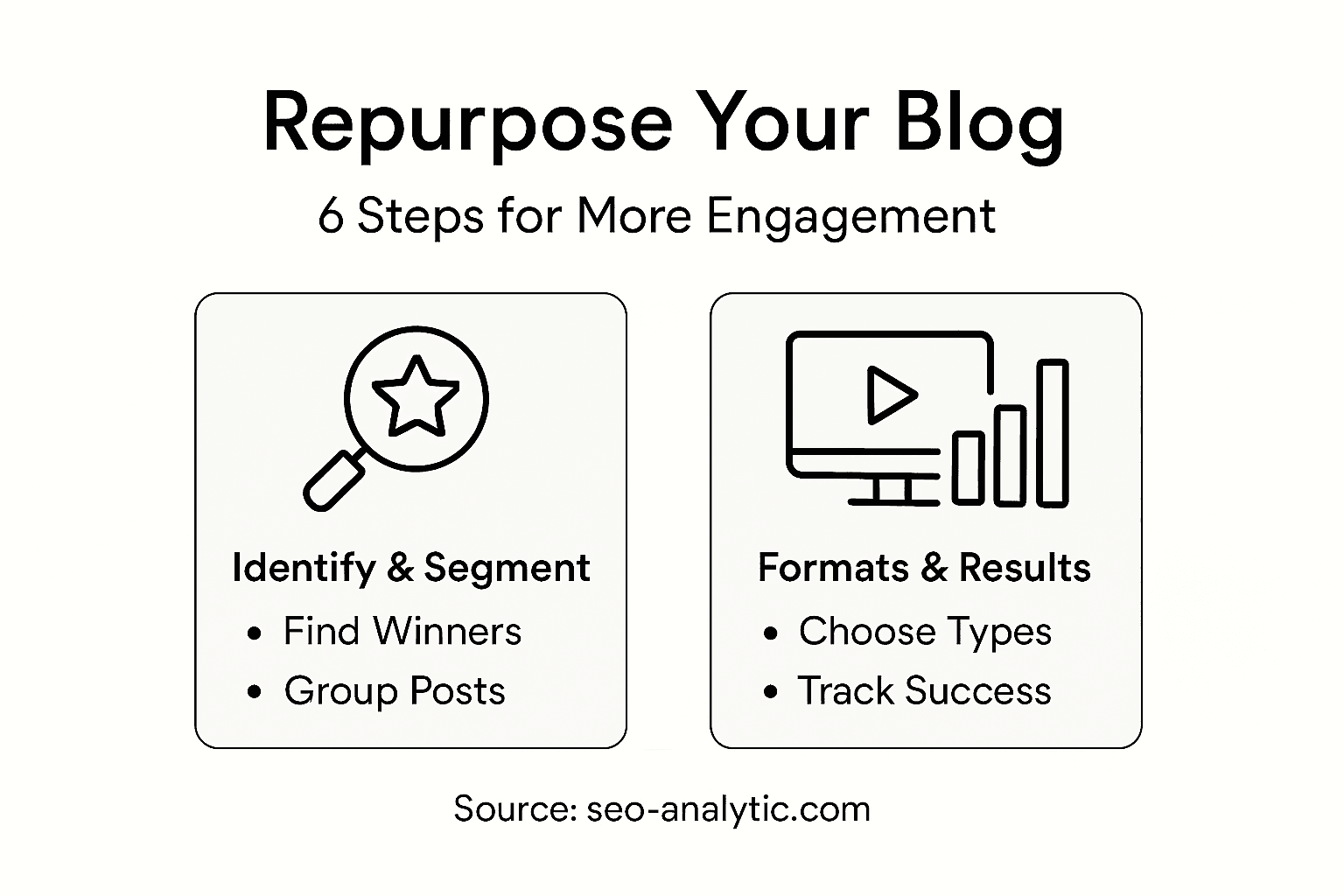
- Step 1: Identify Blog Content with High Potential
- Step 2: Analyze and Segment Content for Repurposing
- Step 3: Select Effective Repurposing Formats
- Step 4: Create and Customize Repurposed Assets
- Step 5: Distribute and Promote Across Channels
- Step 6: Monitor Results and Refine Strategy
Quick Summary
| Key Point | Explanation |
|---|---|
| 1. Identify High-Potential Content | Evaluate existing blog posts using engagement metrics to find content worth repurposing. |
| 2. Analyze and Segment Effectively | Break down blog library into actionable segments based on thematic consistency and performance. |
| 3. Choose Appropriate Formats | Transform content into suitable formats like infographics, videos, and podcasts to maximize reach. |
| 4. Customize for Each Channel | Tailor repurposed content to specific platforms while maintaining brand consistency. |
| 5. Monitor Performance Continuously | Track engagement metrics to refine strategies and enhance future content repurposing efforts. |
Step 1: Identify Blog Content with High Potential
Transforming existing blog content into powerful marketing assets requires strategic identification of your most promising materials. When evaluating blog posts for repurposing, you need a systematic approach that pinpoints content with maximum potential for audience engagement and value generation.
Start by analyzing your existing blog library using key performance metrics. Look for content that demonstrates strong audience interaction, including posts with high view counts, significant social media shares, and substantial reader comments. Credible blog content assessment involves examining several critical factors:
- Traffic volume from organic search and referral sources
- Engagement metrics like average time on page and scroll depth
- Social media performance including share count and viral potential
- Evergreen topic relevance that maintains long-term reader interest
Your goal is identifying blog posts that possess inherent value beyond their original publication date. Focus on content that addresses persistent audience questions, offers unique insights, or provides actionable strategies. When evaluating blog credibility, prioritize posts written by recognized industry experts with demonstrable authority in their field.
To help you prioritize blog posts for repurposing, see how value traits impact long-term potential:
| Value Trait | Impact on Repurposing Success | Example Characteristic |
|---|---|---|
| Evergreen Relevance | Ensures ongoing audience interest | Answers timeless questions |
| Expert Authority | Increases credibility and shareability | Authored by industry leader |
| Actionable Insights | Enhances utility in new formats | Provides step-by-step guidance |
| Unique Perspective | Stands out in saturated content markets | Offers rare case studies |
High-potential content transcends immediate publication – it becomes a renewable resource for your marketing ecosystem.
Pro tip: Leverage analytics tools to track historical post performance and uncover hidden content gems that can be strategically repurposed.
Step 2: Analyze and Segment Content for Repurposing
Successfully repurposing blog content requires a strategic approach to analyzing and segmenting your existing materials. Your mission is to transform scattered content into a cohesive, multi-channel marketing strategy that maximizes audience engagement and delivers consistent value.
Content analysis techniques help you systematically break down your blog library into actionable segments. Focus on identifying content with these key characteristics:
- Thematic consistency that aligns with your brand messaging
- Evergreen topics with lasting relevance
- High-performing content based on historical engagement metrics
- Adaptable narratives that can be reimagined across different formats
When evaluating source credibility, segment your content by examining its original purpose, depth of insight, and potential for transformation. Look for blog posts that offer comprehensive explanations, unique perspectives, or data-driven insights that can be repackaged into different content types like infographics, videos, podcasts, or social media snippets.
Effective content segmentation turns individual blog posts into a versatile marketing ecosystem.
Pro tip: Create a content matrix that maps each blog post’s potential repurposing pathways, helping you visualize and prioritize your content transformation strategy.

Step 3: Select Effective Repurposing Formats
Transforming your blog content into diverse formats requires a strategic approach that maximizes audience reach and engagement. Your goal is to breathe new life into existing content by selecting repurposing formats that resonate with different audience segments and platform requirements.
Content repurposing strategies involve carefully matching your original content with formats that enhance its impact. Consider these powerful transformation options:
- Infographics for visual learners and social media sharing
- Short video clips that capture key insights
- Podcast episodes exploring in-depth topics
- Social media snippets for quick, shareable content
- Ebooks for comprehensive long-form exploration
When selecting appropriate content formats, analyze your original content’s core message and identify the most suitable medium. Some blog posts work brilliantly as step-by-step videos, while others might shine as podcast discussions or visually compelling infographics.
Here’s a comparison of common repurposing formats and their ideal use cases:
| Format Type | Best For | Content Strengths |
|---|---|---|
| Infographic | Quick data, visual summaries | Simplifies complex topics |
| Short Video Clip | Key insights, how-tos | Engages visual learners |
| Podcast Episode | Deep dives, interviews | Adds voice and personality |
| Social Snippet | Teasers, quotes, quick facts | Drives fast audience engagement |
| Ebook | Comprehensive guides | Offers in-depth, lasting value |
Not all content is created equal – choose formats that amplify your message and engage your target audience.
Pro tip: Develop a flexible content matrix that maps each blog post to multiple potential formats, allowing you to quickly pivot and maximize your content’s versatility.
Step 4: Create and Customize Repurposed Assets
Transforming your existing blog content into engaging, platform-specific assets requires careful customization and strategic design. Your mission is to reimagine your original content in ways that capture audience attention and deliver value across multiple channels.
Content repurposing best practices involve maintaining brand consistency while adapting your message to different formats. Consider these key customization strategies:
- Simplify complex ideas for bite-sized social media content
- Extract key statistics for infographic design
- Develop visual storytelling elements for video and graphics
- Condense long-form content into punchy podcast scripts
- Highlight unique insights that work across different mediums
Each repurposed asset should feel intentionally crafted for its specific platform. A blog post about marketing strategies might become a series of animated Instagram stories, a detailed YouTube tutorial, or a concise LinkedIn carousel that highlights key takeaways.
Successful content repurposing transforms a single piece of content into a multi-platform storytelling experience.
Pro tip: Create a comprehensive style guide that outlines your brand’s visual and tonal requirements, ensuring consistency across all repurposed content formats.
Step 5: Distribute and Promote Across Channels
Expanding your content’s reach requires a strategic multichannel distribution approach that maximizes visibility and engagement. Your goal is to transform repurposed content into a powerful marketing ecosystem that connects with audiences across different platforms.
Content distribution strategies enable you to amplify your message through targeted, platform-specific approaches. Implement these key distribution tactics:
- Tailor content for each social media platform’s unique audience
- Schedule strategic posting times for maximum engagement
- Cross-promote related content across different channels
- Leverage platform-specific features like stories, reels, and carousels
- Track performance metrics to refine distribution strategy
When optimizing content recycling, consider the specific nuances of each platform. An in-depth blog post might become a LinkedIn article, Instagram carousel, Twitter thread, and YouTube explainer video – each crafted to resonate with that platform’s audience.
Effective content distribution transforms a single piece of content into a comprehensive, multi-platform narrative.
Pro tip: Create a content distribution calendar that maps out specific formats, platforms, and posting schedules to ensure consistent and strategic content promotion.
Step 6: Monitor Results and Refine Strategy
Successful content repurposing requires continuous evaluation and strategic adjustment. Your goal is to develop a dynamic monitoring system that helps you understand the performance of your repurposed content and make data-driven improvements.
Content evaluation frameworks emphasize establishing robust tracking mechanisms to measure engagement and effectiveness. Focus on these critical monitoring strategies:
- Track engagement metrics across different platforms
- Analyze audience interaction with repurposed content
- Compare performance between original and repurposed assets
- Identify high-performing content formats
- Gather qualitative feedback from your audience
Each piece of repurposed content offers valuable insights into audience preferences and content effectiveness. By systematically collecting and interpreting performance data, you can continuously refine your content strategy, optimizing future repurposing efforts.
Monitoring is not just about measuring results – it’s about understanding the story behind the numbers.
Pro tip: Develop a standardized reporting template that allows quick, consistent comparison of content performance across different platforms and formats.
Maximize Your Blog Content’s Impact with Expert Digital Marketing Solutions
Struggling to transform your blog content into consistent, high-engagement assets? This article highlights key challenges like identifying evergreen content, selecting effective repurposing formats, and distributing across channels to boost visibility and conversions. If you want to overcome content fragmentation and ensure your marketing efforts deliver measurable results, strategic website development and tailored digital marketing are essential.
Our team specializes in creating adaptable online experiences that amplify your blog’s reach while optimizing for search engines and social platforms. We understand the importance of converting visitors into loyal customers by aligning content strategy with powerful website solutions. Explore how our Website Development – seo analytic expertise can help you build a multi-channel storytelling ecosystem. Discover all the ways we support growth on our Our Services – seo analytic page.

Ready to unlock the full potential of your blog content? Visit https://seo-analytic.com today and start turning your valuable articles into dynamic marketing assets that deliver maximum engagement and business growth.
Frequently Asked Questions
What is the best way to identify blog content for repurposing?
To identify blog content with high potential, analyze key performance metrics like traffic volume, engagement metrics, and social media performance. Focus on content that addresses ongoing audience questions or provides unique insights to maximize its value.
How can I segment my blog content effectively for repurposing?
Segment your blog content by examining its theme, relevance, engagement metrics, and adaptability. Create a content matrix to visualize potential repurposing pathways and prioritize your materials accordingly.
What formats should I consider for repurposing my blog content?
Consider formats such as infographics, short video clips, podcast episodes, or ebooks based on the core message of your original content. For example, a blog post that provides step-by-step guidance may work well as a short video tutorial.
How can I customize repurposed content for different platforms?
Customize your repurposed content by simplifying complex ideas and extracting key insights tailored for specific platforms. Ensure that each asset feels crafted for its unique audience, whether it’s a visually compelling infographic or a detailed podcast script.
What strategies should I use for distributing repurposed content?
Tailor your distribution strategies for each platform by scheduling posts at optimal times and using platform-specific features. For maximum engagement, cross-promote related content across different channels and track performance metrics to refine your approach.
How do I monitor the success of my repurposed content?
Track engagement metrics and audience interactions with your repurposed content to measure its success. Set up a standardized reporting template to compare performance across platforms and continuously adjust your strategy based on the data.
Recommended
- 7 Key Business Blog Benefits Every Owner Should Know – seo analytic
- Complete Guide to Creating Shareable Content – seo analytic
- Understanding Blogging for Business: Key Insights Explained – seo analytic
- Engagement on Social Media: Complete Guide for 2025 – seo analytic
- 7 Smart Ways to Boost Events in Cedar City Utah